

Seasickness: Why it happens and how to manage It
Updated: May 2

One question almost everyone asks before their first sailing trip is this:
“What if I get seasick?”
It’s a completely fair concern. Spending several days on a moving boat can sound intimidating if it’s your first time.
However, the most important thing to know is that humans have been mastering the sea for thousands of years.
Even the ancient Greeks, including the physician Hippocrates, studied the relationship between motion and the body. While the word "nausea" does share its roots with the Greek word for "ship," it’s also a reminder that we’ve had centuries of experience in learning how to prevent and manage it.
The best part? Modern sailing is worlds away from ancient times. Most people find they don’t experience serious discomfort at all, and for those who do, it’s usually just a brief "transition period" while the body finds its rhythm with the waves.
Let`s start with the basics.
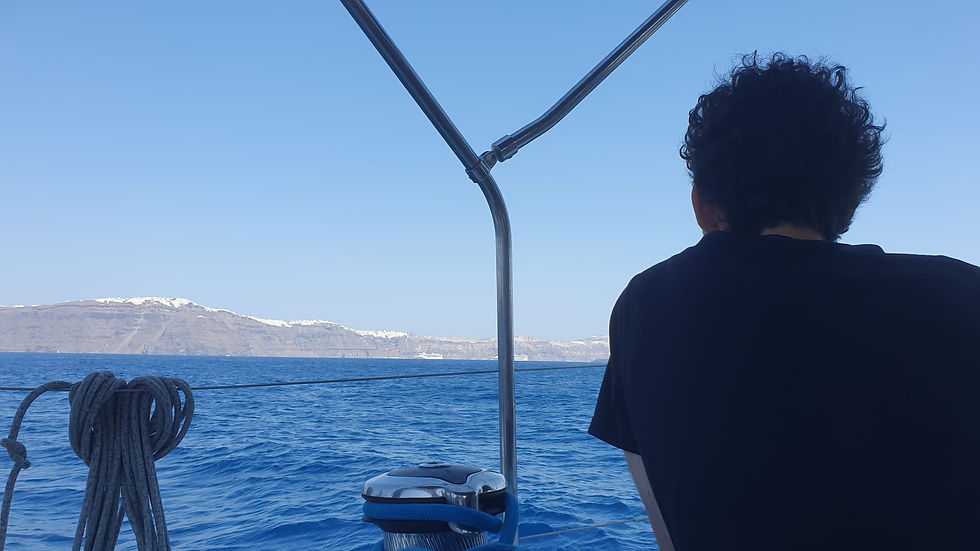
Why It Happens (The "Mismatch")
In simple terms, seasickness is a sensory mismatch.
Your inner ear, which controls balance, senses the movement of the boat. However, if your eyes are focused on something stable (like a book or the interior of the cabin), your brain receives conflicting information.
This confusion can lead to dizziness, fatigue, or nausea.
The brain is remarkably adaptable, though. Within a few hours, sometimes even less, most people find their "sea legs" as the body syncs up with the motion of the boat.
Simple habits for immediate relief

Prioritize fresh air: Stay in the cockpit rather than the cabin. Fresh air and a wide view help your brain process the motion.
Fix your gaze on the horizon: This is the oldest trick in the book. It aligns your vision with the boat’s movement. This is also why you should avoid looking down at a phone or a book for long periods.
Take the helm: If the skipper allows, try steering the boat for a while. It’s one of the best ways to regain your equilibrium.
Prepare your body: Arrive well-rested and hydrated. Avoid alcohol before and during the initial sail, as it significantly increases motion sensitivity.
The power nap: Sometimes the best fix is to lie down for a short while and let your body settle.
Natural remedies and medication
Many sailors keep a variety of remedies on hand, as different solutions work for different people.
Natural Options

Ginger is a classic choice that many find helpful, even if scientific evidence
remains mixed.
Similarly, acupressure wristbands are a popular non-medicinal option; while some studies suggest a placebo effect, many sailors swear by them, and in practice, if it works for you, that’s what matters.
Medication
For stronger prevention, over-the-counter medications are widely available. Common options include:
Dimenhydrinate (e.g., Dramamine)
Meclizine
Cinnarizine (commonly sold as Stugeron in Europe)
These help the brain manage conflicting signals from the inner ear.
The Golden Rule: These work best when taken before symptoms appear.
Note: Always check with your doctor before using medication, especially if you have existing health conditions.
Choosing the right boat can also help
The type of boat you choose can also make a big difference in how you feel. If you’re worried about being sensitive to motion, catamarans are a fantastic choice. Because of their two-hull design, they sit flatter and feel much more stable on the water than traditional monohulls.

Many first-time sailors find them especially comfortable in calm cruising conditions. Because they have two hulls, catamarans offer a lot more living space and, most importantly, they don’t 'heel' or lean over as much when the wind picks up. We’ve put together a quick guide comparing catamarans and monohulls to help you decide which one fits your own style of adventure.
Don’t let fear hold you back
Sailing might seem intimidating at first, but it’s usually much gentler and more comfortable than people expect. To help you imagine the experience beyond the logistics, we’ve shared a closer look at what to expect during your very first week at sea.
And yes, sometimes people can feel a bit seasick. If it happens, just let the crew know. There’s absolutely no embarrassment around it.
We’ve seen it before and know how to help you get back to enjoying the wind, the salt air, and the quiet freedom of the open sea.

The Funny Twist: "Land Sickness"
Here’s something many first-time sailors don’t expect:
After a few days at sea, your body gets so used to the gentle rhythm of the boat that when you finally step back on solid ground, the earth might feel like it’s still moving.
Sailors jokingly call this “land sickness”, that strange sensation that the dock is still rocking under your feet. It usually disappears after a few hours, but it’s always the perfect final reminder of just how much time you spent connected to the water.
And if it happens to you, there’s a very good chance your next thought will be: “I think I need to get back on a boat soon.“

